What Does Extra Virgin Olive Oil Mean? The EU Rules Explained
Extra virgin is the top EU grade of olive oil. We explain the limits, how it differs from virgin oil, and what to look for on a label.

Quick answer: Extra virgin is the top grade of olive oil under EU rules. It is oil made only by mechanical means, with free acidity of 0.80% or less, no taste defects and a fruity character. Virgin olive oil, one step down, may have up to 2.0% acidity and mild defects.
So what does extra virgin olive oil mean on a bottle? It means the oil passed a set of lab tests and a taste panel, and it was never refined. The grade is a legal category. It says nothing about flavor style or how fresh the oil is today.
Key takeaways
- Extra virgin and virgin oils are both made directly from olives by mechanical means only, with no solvents and no refining.
- Extra virgin must show free acidity of 0.80% or less, and a taste panel must find no defects and some fruitiness.
- Acidity alone does not prove quality. The EU says it only means something next to peroxide value and UV absorption.
- The grade says nothing about harvest date or how fresh the oil is today. Check the best before date and how the oil was stored.
What does extra virgin olive oil mean?
EU law defines extra virgin olive oil as a "superior category olive oil obtained directly from olives and solely by mechanical means". In practice the olives are crushed to a paste, the paste is mixed, and the oil is separated from water and solids by centrifuge or press. Nothing is added, and no heat or chemical refining is used to correct the oil afterwards.
To carry the name, an oil has to meet every limit in Annex I of Delegated Regulation (EU) 2022/2104. For extra virgin these are:
- Free acidity: 0.80% or less
- Peroxide value: 20.0 mEq O2/kg or less
- K232: 2.50 or less
- K270 (also called K268): 0.22 or less
- Delta-K: 0.01 or less
- Sensory panel: median of defects of 0.0 and a fruity median above 0.0
If an oil misses even one, it drops to a lower grade. Our guide to olive oil acidity explains what free acidity measures and what it does not.
What is the difference between virgin and extra virgin olive oil?
Both are made by mechanical means only. The difference is in the limits. Under the same Annex I, virgin olive oil may have:
- Free acidity up to 2.0%
- K232 up to 2.60 and K270 up to 0.25
- A median of defects up to 3.5, with the fruity median still above 0.0
Virgin olive oil can carry small taste flaws, such as a hint of fustiness, and extra virgin cannot. That is why the panel result counts as much as the lab numbers.
What are the other olive oil grades?
Two more categories show up on shelves, and both start from oil that failed the virgin limits:
- Lampante olive oil has acidity above 2.0% or a median defect above 3.5. It is not sold to consumers as it is.
- Refined olive oil is lampante oil that has been refined. It has little taste.
- "Olive oil" on a plain label means a blend of refined olive oil and virgin olive oils, with a free acidity of 1.00% or less.
Pomace oil is a separate group made from the leftover paste. If the label just says "olive oil", it is not extra virgin. For a closer look at telling the real thing apart, read how to tell if olive oil is real.
Why isn't low acidity enough?
A low acidity number is easy to print on a label, so buyers often read it as a shortcut for quality. The EU regulation says acidity in isolation suggests an absolute scale of quality, which misleads consumers. It only has meaning together with peroxide value, wax content and ultraviolet absorption. For that reason, when a label states a maximum acidity, it must also state the maximum values for those other three, in the same size and the same visual field.
We still publish acidity, because buyers ask for it. For each of our oils we set a threshold, and we select against it: acidity up to 0.3% for Crete, up to 0.25% for BIO Crete and up to 0.3% for Lesvos. Read our published lab analyses to see the full set of values and the lab that reported them.
How is the extra virgin grade checked?
The grade is checked twice. A lab measures free acidity, peroxide value, UV absorption and other markers using methods set in EU law. Separately, a trained panel of tasters, working to the International Olive Council method, smells and tastes the oil and scores any defects and the fruity note.
A 2011 study by the UC Davis Olive Center and an Australian lab tested extra virgin oils sold on California shelves against the IOC standards. All samples passed the chemistry for free fatty acids and peroxide value, while several imported samples failed the UV absorption test.
Because the grade depends on the batch, we publish the lab analyses for our oils. You can read our published lab analyses, and after delivery you can enter the LOT printed on your tin in the LOT lookup to see that batch's analysis.
What should you look for on a label?
- The words "extra virgin olive oil" as the category, not just "olive oil" or "pure".
- A clear origin, such as a place name, and a best before date.
- Dark glass or a tin. Light and heat age oil.
- A way to check the numbers: a lab analysis you can read, not only an adjective.
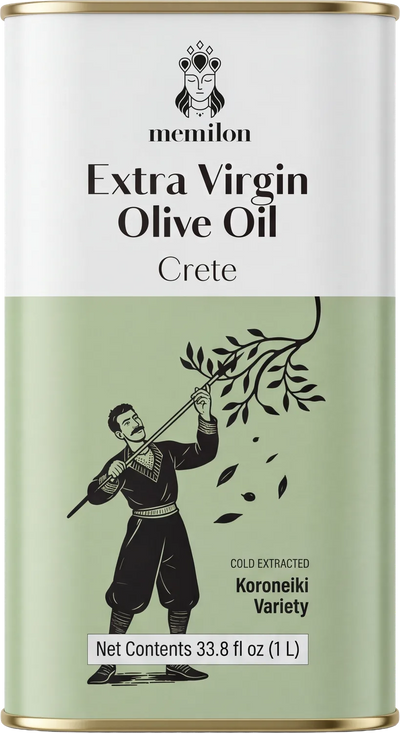
Our three oils are all extra virgin: Memilon Crete (Koroneiki from Phaistos), Memilon BIO Crete (organic Koroneiki from Phaistos) and Memilon Lesvos (Kolovi from Plomari). They are all cold extracted and never blended. See the full range at all Greek olive oils.
FAQ
What does extra virgin mean for oils?
It is the highest EU category for olive oil: made directly from olives by mechanical means, with free acidity of 0.80% or less, no taste defects and a fruity note.
What is the shelf life of extra virgin olive oil?
Many oils carry a best before date about two years after bottling. Light, heat and air shorten that, so keep the tin or bottle closed and cool. Our article on how long olive oil lasts has the details.
How is extra virgin olive oil made?
Olives are washed, crushed into a paste and mixed. The oil is then separated from the water and solids by centrifuge or press, at a temperature that stays under 27 °C if the producer wants to call it cold extracted. No solvents and no refining are allowed.
How can you tell if olive oil is 100% real?
No kitchen test is reliable. The category on the label, a clear origin and a lab analysis you can read are the best signals, and our guide to spotting a great extra virgin olive oil goes through them.
Sources
- Commission Delegated Regulation (EU) 2022/2104, marketing standards for olive oil (EUR-Lex)
- UC Davis Olive Center, Evaluation of Extra-Virgin Olive Oil Sold in California
This article gives general information about olive oil categories under EU rules. Limits can change, so check the current regulation.
Keep Reading
How to Read an Olive Oil Lab Analysis and LOT Number
An olive oil lab analysis lists a few measured values, from acidity to K values. We explain each line, the extra virgin...
Read the article
Olive Oil vs Rapeseed Oil: Which Fits Your Kitchen?
Olive oil vs rapeseed oil compared on fat profile, cooking and taste, with USDA data and our published lab analyses.
Read the article
Cold Pressed vs Cold Extracted Olive Oil: The Label Explained
“First cold pressing” on a label means a first pressing with hydraulic presses below 27 °C. Here is what the EU rules...
Read the article